Every company I've walked into has one. Sometimes it's Budi, sometimes Sari, sometimes "the lady in finance who's been here since 2012." You know the type.
Budi knows the real stock count, not the one in the spreadsheet. He knows which customer still owes you money. He remembers that Pak Hendra gets a special price, but only above 50 cartons, and only if he pays within 14 days.
So, your business already has a system. It's called "Ask Budi." And it works fine, right up until Budi gets sick, takes leave, or joins your competitor
Short answer: A business should start using an ERP system when the same information (orders, stock, invoices, payments) passes between more than two people every day, or when more sales means hiring more admin just to keep up. For most growing SMEs, that moment comes earlier than they think
Manual work vs a business system: which is really cheaper?
It feels cheaper. No license fee, no consultant, just spreadsheets and a WhatsApp group. But you're already paying. The bill just doesn't show up on your P&L.
You pay in time, because the same order gets typed by sales, then the warehouse, then finance. You pay in mistakes, because every manual copy gives a 5 the chance to become an 8. You pay in late information, because your sales recap arrives on the 10th of next month. And you pay with your evenings, fixing numbers at 11 PM because nobody else understands the file.
This isn't just a hunch. When auditors inspected 85 real business spreadsheets in detail, 94% of them contained errors! And in a 2025 survey of 100 finance professionals, 94% still used Excel to close the books, while half said Excel was a key reason their close was slow.
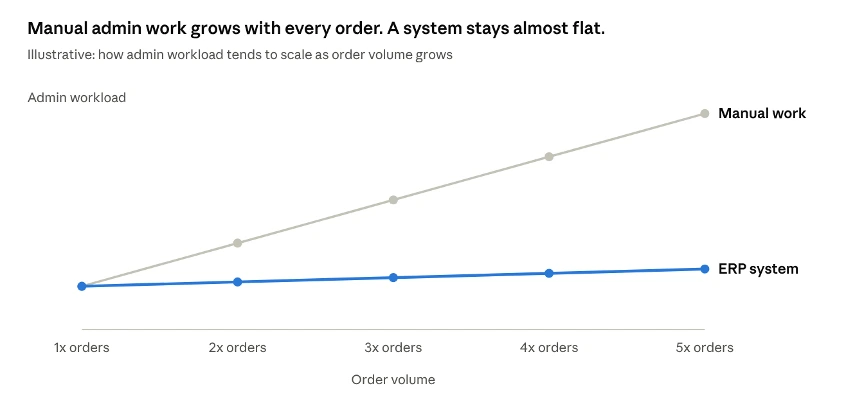
With manual work, every jump in orders needs more hands. With a system, the same team handles the extra volume
5 signs your business has outgrown spreadsheets and needs a system
Remember when your whole business fit in one Excel file? You knew every customer by name, every order by heart, and stock was whatever you saw in the warehouse. Then orders picked up, you hired a few people, and somehow that one file turned into ten, plus a WhatsApp group, plus a notebook only Budi can read. Nobody decided this. It just happened. Sound familiar? Here's how to tell:
- There's a WhatsApp group whose main job is asking "Is this still in stock?"
- Your files are named Sales_FINAL_v3_REAL_revisi.xlsx, and three people have three "final" versions.
- Closing the books takes the first two weeks of every month.
- Your stock count and your spreadsheet disagree, and both sound very confident.
- More orders make you nervous instead of happy
Three or more? You're not disorganized. You've just grown past the tools that got you here.
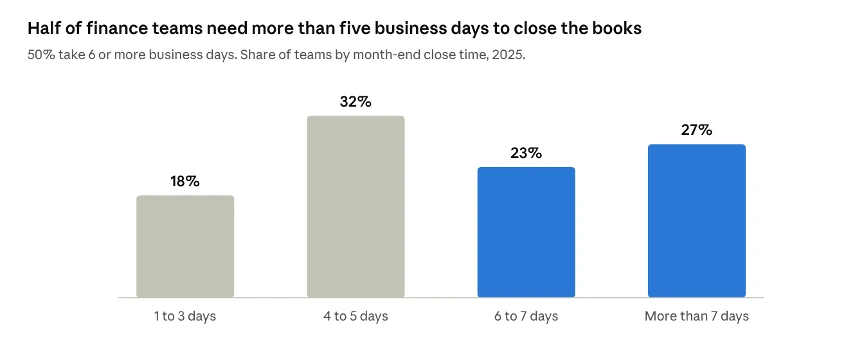
Sign number 3 is more common than you'd think. Only 18% of finance teams close their books in three days or less
What is an ERP system, in plain words?
An ERP system is a business management system that connects sales, inventory, purchasing and accounting in one shared database, so every team works from the same live information.
Right now, your business probably runs like a relay race with a paper baton. Every handover is a chance to drop it. With an ERP, there's no baton. Confirm an order and stock is reserved. Ship it and stock goes down. Send the invoice and the books update. One entry, no retyping.
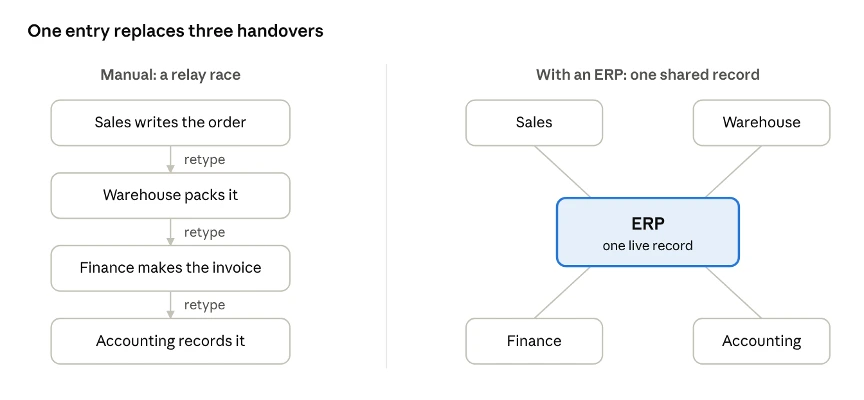
On the left, the same order is retyped three times. On the right, every team reads and updates one shared record.
What changes for you as the owner:
- You stop guessing. Today's sales, stock and cash, on your phone.
- Mistakes get caught early, by the system instead of your customer.
- You grow without adding admin for every new batch of orders.
- Your business stops depending on heroes. Budi can finally take his leave
Is an ERP system right for a small business?
"We're too small for an ERP." I hear this from small business owners every week. Ten years ago, it was true. Today, modular platforms like Odoo let you start with one module, say inventory or invoicing, and add more later. You don't buy the whole house on day one. You start with one room.
And waiting until you're bigger usually costs more. Putting in a system in the middle of chaos is like renovating the kitchen during a wedding reception.
if your business model still changes every month, or nobody can explain how your process works today, map the process first. Software makes a good process great. It makes a messy process messy faster
The numbers back this up. Panorama Consulting's 2026 ERP Report found that more than a quarter of organizations went over their ERP budget, most often because they needed extra technology after discovering gaps late in the project. Mapping your process first is how you stay out of that quarter.
So Where do i start?
Think of it like moving house. You don't pack everything in one night and hope for the best. You sort what you have, throw out what you don't need, and move room by room. Putting in a system works the same way
- Map how work really flows today, WhatsApp shortcuts and all.
- Pick the area that hurts most and start there.
- Clean your data before you move it.
- Choose one or two internal champions.
- Add more modules as the business grows.
The first few weeks will feel a little awkward, like breaking in new shoes. Someone will still reach for the old spreadsheet out of habit. That's normal. Give it a month, and the day you check today's stock from your phone instead of calling the gudang, you'll wonder how you ever ran things the old way
Budi deserves a holiday
A system isn't about replacing people. It's about freeing your best people from being walking databases. The real question isn't "Am I big enough?" It's "How much longer can I run on memory, spreadsheets and luck?"
If a few of those signs felt familiar, it might be time for a proper business system. Let's talk. At PT Nayaka Solusi Digital, we help growing businesses in Indonesia implement Odoo ERP step by step, starting with what hurts most.
Source:
- Panko, R. R. (2015). What We Don't Know About Spreadsheet Errors Today. Proceedings of the EuSpRIG 2015 Conference.
- Ledge (2025). Month-end close benchmarks for 2025. Survey of 100 finance professionals.
- Panorama Consulting Group (2026). The 2026 ERP Report, press release.